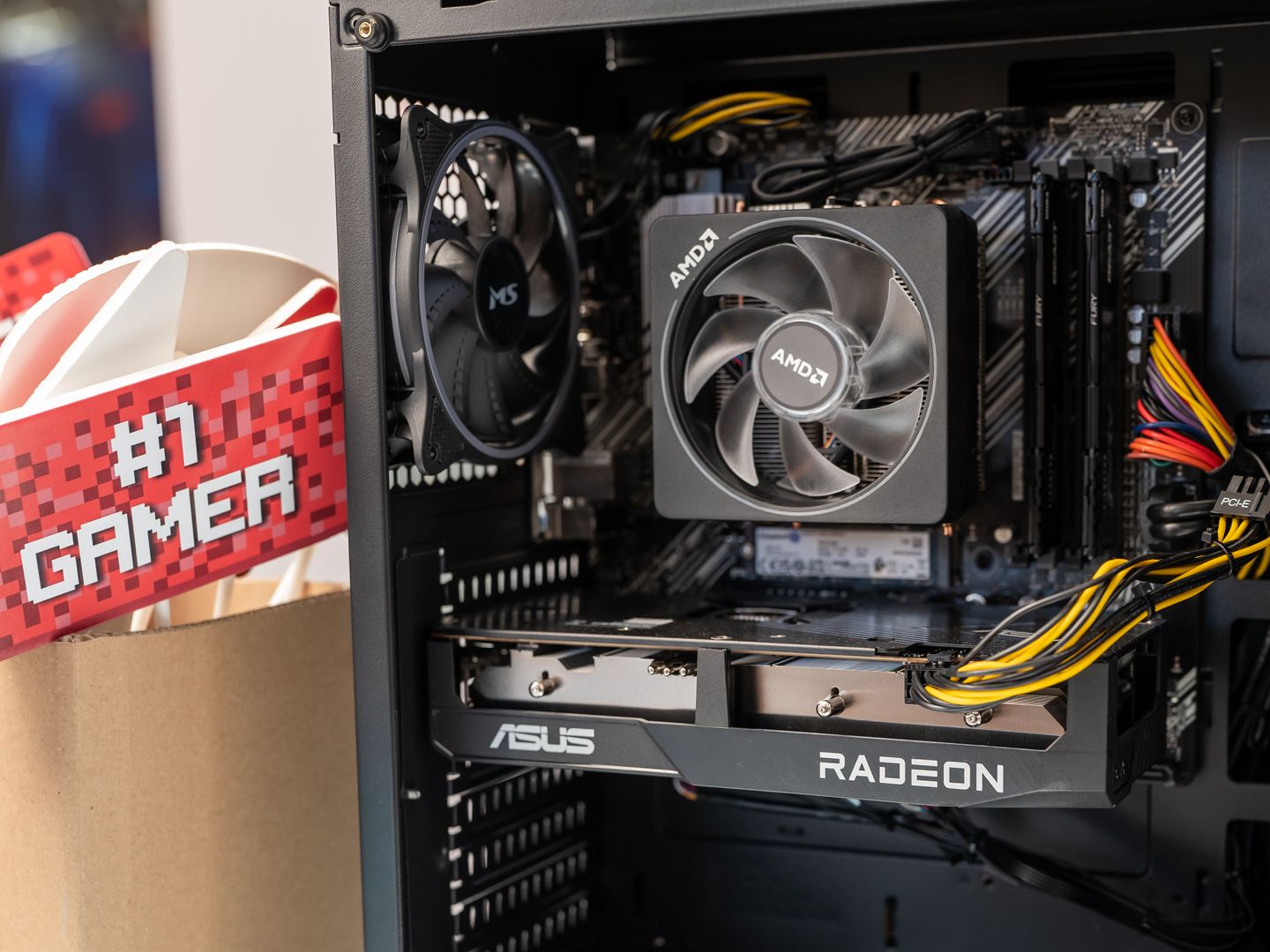
Here's the clean shortlist most people should start with. If you're chasing the absolute ceiling, the GeForce RTX 5090 is the «no apologies» option: 32GB of GDDR7 on a 512-bit bus and a massive 575W total graphics power rating, plus Blackwell's newest RT/Tensor hardware. If you want a top-tier card that's still a little more sane to build around, the GeForce RTX 5080's 16GB of GDDR7 and 256-bit memory interface has become the practical high-end sweet spot.
On the AMD side, the Radeon RX 9070 XT remains the value brawler in the upper-midrange—16GB GDDR6, a 256-bit bus, and a 304W TBP at an original $599 SEP—while Intel's Arc B580 is still the budget disruptor with 12GB GDDR6, a 192-bit interface, and 456 GB/s memory bandwidth at a $249 launch price.
The ranked picks cover almost every gaming rig you'll see in the wild right now. NVIDIA GeForce RTX 5090 is best for no-compromise 4K with ray tracing headroom plus serious creator capability, though it's power-hungry (575W) and rarely the most rational dollars-per-frame choice. GeForce RTX 5080 delivers high-end balance with 10,752 CUDA cores and 16GB of GDDR7 on a 256-bit bus — the high-end card that still makes sense for «normal» enthusiast builds.
AMD Radeon RX 9070 XT hits the practical sweet spot at 1440p: 16GB VRAM, strong 1440p performance, and a 304W TBP that's easier to cool than top-end monsters. The trade-off is feature preference—if you're all-in on NVIDIA's DLSS ecosystem or certain creator pipelines, RTX can still be the smoother ride. NVIDIA GeForce RTX 5070 Ti is the card for players who want 1440p high refresh, solid ray tracing, and a modern frame-generation stack without moving into true high-end pricing.
AMD Radeon RX 9070 remains a clean step down that still keeps the all-important 16GB VRAM and a 256-bit bus, with a 220W TBP and a $549 SEP in its original positioning. In the midrange, memory capacity can matter more than small core-count differences. NVIDIA positioned the RTX 5060 Ti 16GB at a $429 MSRP, and for modern texture-heavy games the 16GB model is the one worth considering for longevity.
AMD's RX 9060 XT came in two memory configurations, with an 8GB SEP of $299 and a 16GB SEP of $349. In 2026, the 16GB version is the smarter «buy once, cry less» play for 1080p and entry 1440p builds—especially if you keep cards longer than one upgrade cycle. The B580 remains the most interesting budget card when you want modern features without getting trapped in 8GB VRAM frustration, trading some consistency in older titles and the occasional driver oddity for a lot of memory and a very friendly launch price.